
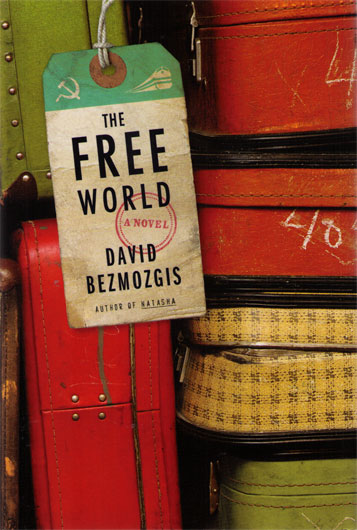
The Free World
by David Bezmozgis (2011)
Farrar, Straus and Giroux (2011)
368 pp
Last year The New Yorker included David Bezmozgis when they highlighted twenty young fiction writers in their “20 Under 40” series. Bezmozgis’s piece, “The Train of Their Departure,” was one of my favorites, a somewhat rare case when I felt like the excerpt from a novel worked as a complete and interesting short story. The novel it came from is The Free World, which was recently placed on the Giller Prize longlist. KevinfromCanada considers this one of his favorite books of the year (his review here). I personally thought the short story was better (his debut, Natasha, was a highly regarded collection of short stories; The Free World is his first novel). However, don’t take that to mean I’ll be putting up a fight should this turn out to be a contender as the winner of the Shadow Giller; it’s a wonderful book.
The book begins with dislocation. We are on a train platform in Vienna, which is neither the origin nor the destination for the Krasnansky family. It is 1979, and, somewhat against the odds, they have just left Soviet Russia and are headed to Rome, thence to who-knows-where — maybe the United States, maybe Australia, maybe Israel, maybe even Canada. The first member of the family we meet is the philandering Alec. They family has arrived in Vienna and must transfer all of their luggage from one train to the next, but Alec takes a moment to look around at the many people in transit.
His own family roiled among them: his parents, his wife, his nephews, his sister-in-law, and particularly his brother, Karl, worked furiously with the suitcases and duffel bags. He should have been helping them but his attention was drawn farther down the platform by two pretty tourists.
Alec goes so far as to imagine a quick conversation with the two pretty tourists, imagining them being from Chicago, happy to talk to him because he will tell them that is where he is going. Meanwhile, in the back of the reader’s mind is a question: didn’t we just read that he has a wife who is busy working with the luggage? Somehow in these first few pages, Bezmozgis, with understatement, gives us a selfish character that we can’t help but be attracted to, and we get a sense of his relationship with the whole family. As I mentioned above, for me Bezmozgis works best when he’s working on the smaller scale, and this opening scene could be a short story in and of itself — a fantastic look at flux through the eyes of a few well drawn characters.
The story doesn’t focus all of its attention on Alec. In fact, soon it is Polina, his wife, who takes center stage as her own dislocation is developed. Polina was unhappily married when she met Alec. It’s not that her husband was bad to her; on the contrary, he was entirely proper, and she felt a severe lack of passion. As we saw from the first page, Alec is eager to supply passion. Interestingly, though the bulk of this novel is about how the Krasnansky family toils in Rome to find passage to anywhere where they can settle down, Bezmozgis spends a lot of time developing Polina’s back story, including her brutally detached courtship with her first husband (“The Train of Their Departure” focuses on this as well). Polina’s story was a highlight for me, and maybe that’s one reason I found some of the rest of the book wanting. I just didn’t feel as connected to, say, Karl and his family, or even Alec, and passages dedicated to their point of view paled a bit in comparison to the richness of Polina’s.
I don’t want to give the impression that the other stories — the onest that show the brothers’ attempts to get a leg up in Rome as they try to both expedite their departure and plan for an indefinite stay — are weak. They are not, and I believe they make Polina’s story even stronger when we consider her own dislocation. Another character I didn’t want to stop reading about was Samuil Krasnansky, the patriarch of the family. Samuil is 65 in 1979 and lived through the revolution. He knows what life was like before the Soviet state was formed, and he’s devoted his life to supporting the Soviet state. He cannot comprehend why his family would want to leave. Sure, maybe things were not perfect, but they were better than when he was a child. His own children grew up knowing only the Soviet way of life, and without anything to compare it to all they saw were its flaws. His wife, Emma, for her part, really just wants the family to be together:
— You know, I’ve thought about it, Emma said, and what is this except another evacuation? Emigration, evacuation; I don’t see such a difference. At least this time everyone is together.
— Think before you speak, Samuil said. In the war you ran from the enemy. Now who are you running from?
Throughout the novel, Samuil appears to be on the verge of death. At first, he is a bit like Grandpa Joad in The Grapes of Wrath, he just didn’t want to leave and it’s had to imagine he’ll stay alive long after being torn from his roots (Grandpa Joad dies on the first day of the trip). However, Samuil becomes, along with Polina, one of the most fascinating characters I’ve read about this year. Yes, death is next door:
There had been a point — once it became obvious that his sons would leave Riga, that no manner of threats or appeals would deter them, and that his family and his reputation would be destroyed — when Samuil had, for the first time in his life, contemplated suicide. The idea plagued him for weeks. He sought a reason to keep living, to justify his waking-and-breathing participation in the future. Almost certainly he would be expelled from the Party.
But the way out will not be so simple for Samuil, and Bezmozgis shows that a man may be wilfully on the verge of death but “the habit of survival” cultivated through his life doesn’t allow it. Consequently, Samuil, despite looking like a shell after leaving his past behind, becomes a very full character who struggles as the family adopts a new life, a life which includes the tentative reintroduction of of Judaism, which for Samuil is no real root at all.
The Free World is very much a novel about characters grouped together by circumstance, and so those circumstances — Communism, emigration, corruption in the free world — are nicely explored; however, and thankfully, The Free World is more interested in the individual character’s lives. This is not a book that uses prop characters to get something off its chest. As I said above, some of these character’s lives are better done than others, and for me the strongest aspects of the novel were the ones done in miniature, making the book as a whole feel a bit unbalanced. Nevertheless, as Giller season heats up, this is a book to pay attention to, and it deserves that attention despite any of my misgivings.


I’ve only scanned your thoughts here because I haven’t made it to this one yet. Funny: I’d forgotten that that story in TNY (my thoughts on it are here, if you’re curious: I read that series of stories too) was connected to this novel. I enjoyed the story, but might have enjoyed it more if I hadn’t had such high expectations going in (Natasha was a favourite read of mind that year). Still, I’m looking forward to TFW…